NSW South Coast trip, January 2026
In late January some of the family and I went down to Merimbula for a few days camping. Our timing was pretty much spot-on. The couple of days before we arrived it was bucketing down with rain and windy. Flash flooding occurred up and down the coast. We timed it after that spell had passed (just).
I am not going to make full blog posts for the whole trip. There were excursions to a couple of local national parks, and while there are some nice photos, there isn’t a story to tell. I’ll do some photo albums for those bits, but that’s all.
However, there are a few bits that I wanted to do a post on. That’s the whaling history south of Eden. Eden itself is a great place to visit and I have photographed there previously. It also has a great museum that outlines the history of whaling in the area far better than I will here.
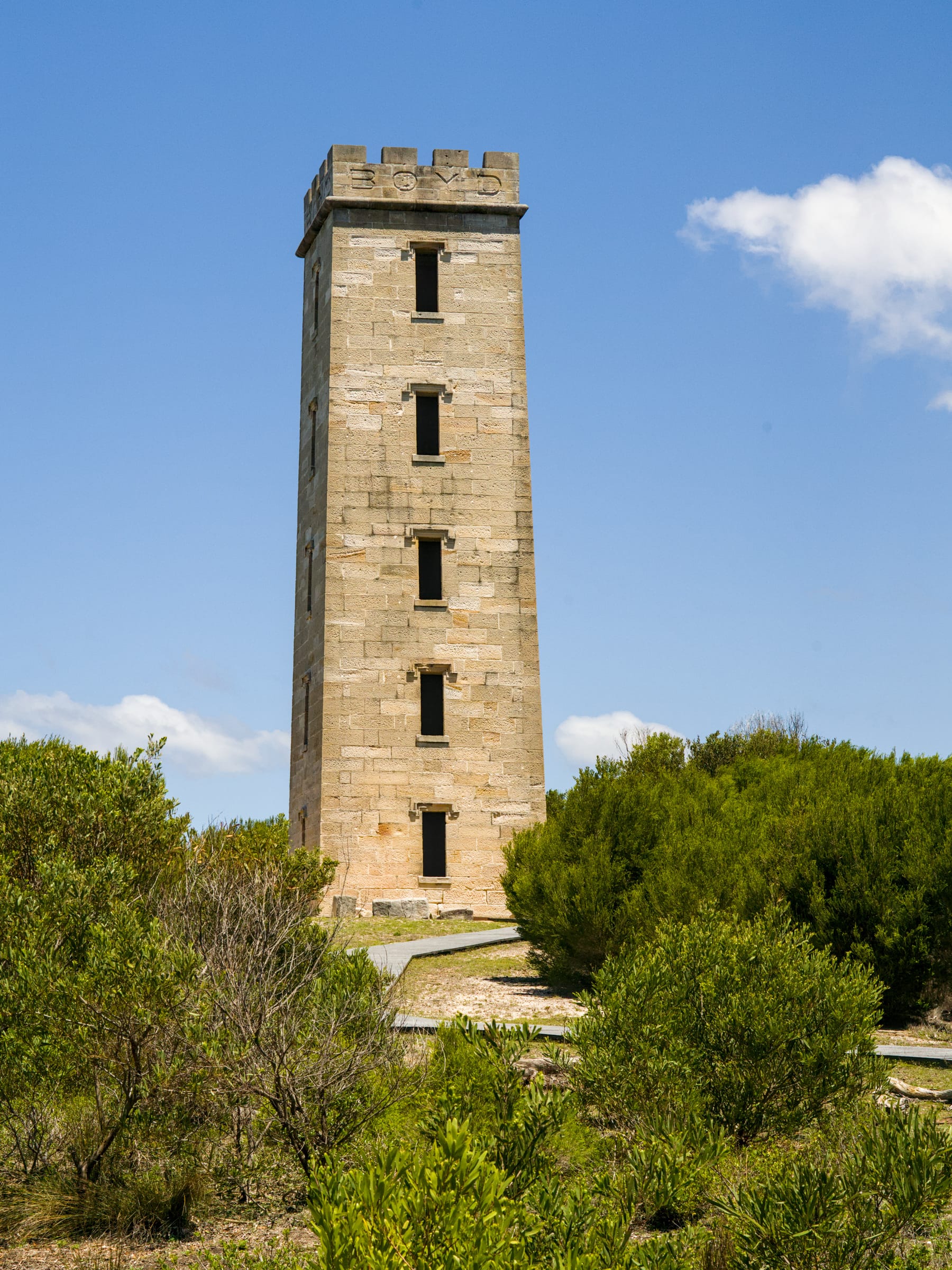
My intention this time, however, was to discover more about the whaling that happened in the southern part of Two-fold Bay. in particular I wanted to visit the remains of Boydtown, the outstanding (in the sense of standing out from a great distance) Boyd’s Tower, and the nearby Davidson Whaling Station.
Boydtown
Boyd (the man) was a character, an ego without the management skills to support his dreams, and, it appears, of somewhat dubious moral character. I say he was an ego because the remnants of his exploits in this part of the world both bear his name. Not because other people named them in his honour, but because he named them in his honour.
There isn’t much left of Boydtown. The Seahorse Inn, by all accounts, is a pretty spectacular building that has been restored and now operates as a pub, restaurant, and accommodation. Wikipedia suggests that the original Inn was constructed by Boyd, and was abandoned along with the rest of Boydtown when Boyd went broke in 1849. The rest of what was once Boydtown is now mostly occupied by a couple of caravan parks, with a few houses off to one side that appear to be a modern subdivision.
The long road up
What I came to see, however, was the ruins of the former Boydtown church. As was not unusual for churches of this time, the church was placed at the highest point within the town. In this case, that means on top of a stand-alone hill that rises fairly abruptly in one corner of the Boydtown site.
If you look at this photo on a small screen, you won’t be able to see my car, but it is there. At the bottom of the hill you can see the driver’s door between two trees – about 1/3 down from the top of the image and a little bit in from the right-hand edge. The car is parked opposite the entry gate to the church. This is the view looking back down the path from the crest of the hill, and the car is approximately 200m away. The church itself is approximately another 50m or so behind me.
I have no doubt people in those days were considerably fitter than I am, but I’m sure it felt like you were doing penance just walking up this hill to church. I can’t help but think that Boyd chose this site more for showing off his grand church than for practical considerations.
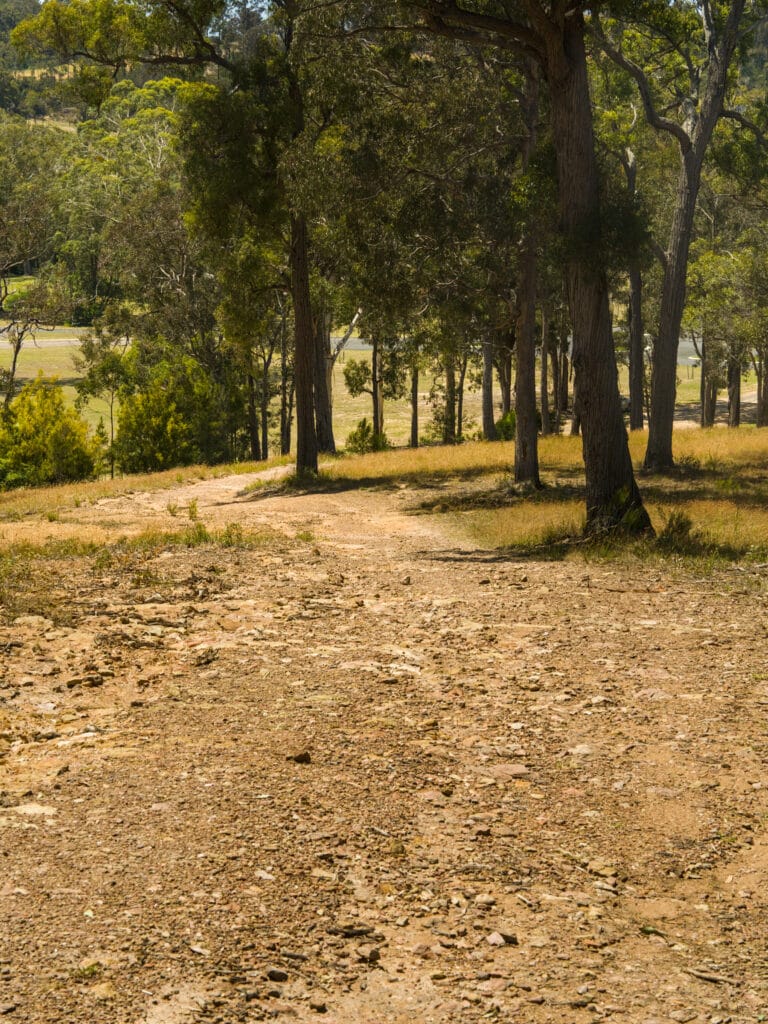
Sony A7Rv with Sony FE 24 – 70mm F2.8 GM II lens @ 70mm. 1/800s, f/18.0, 800 ISO.
The final push
Once you’ve reached the flatter ground at the top, the final 50m or so to the church are a breeze. Quite a commanding position, with a view that would be impressive if it were cleared. Not that I’m suggesting it should be. I do wonder if it was tree’d when the church was in use, or whether, like the european settlers seemed to like doing, they chopped down all the trees.
Because of its dilapidated state, and I suspect also because it was being vandalised, the church is now behind a 2m wire fence. A little bit irritating from a photography perspective, but quite understandable. Do not climb the fence. Let us leave what is left for future generations to enjoy as well. I was able to take photographs through/over/around the fence, and your eyes are more adaptable than the camera.
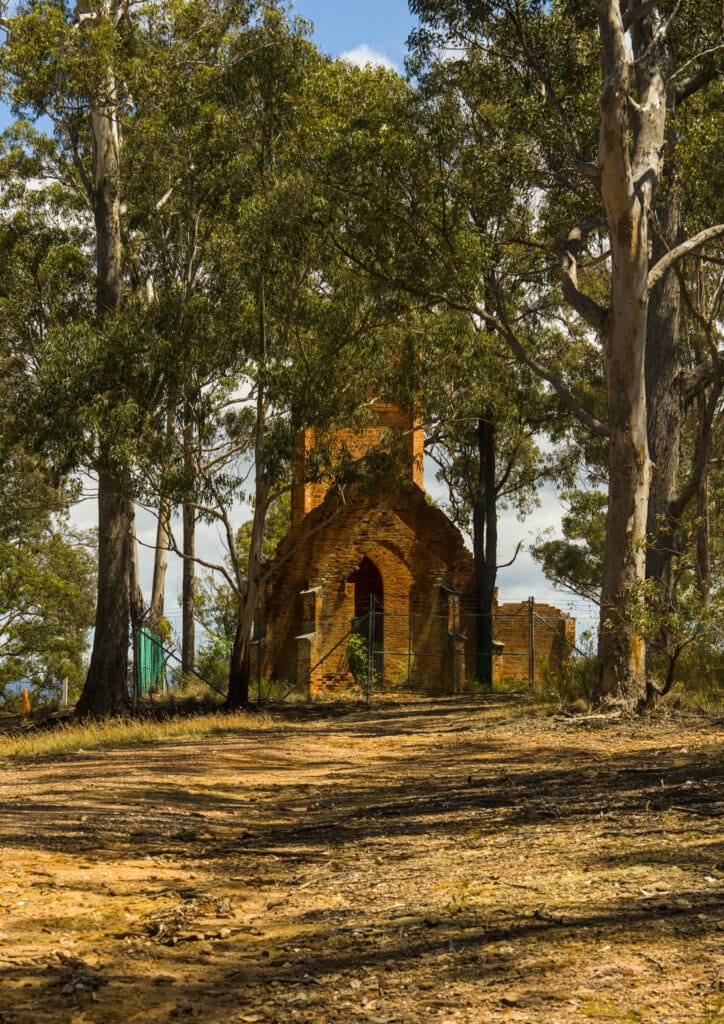
Sony A7Rv with Sony FE 24 – 70mm F2.8 GM II lens @ 70mm. 1/800s, f/11.0, 500 ISO.
Boydtown church ruins
And finally, to the church itself. It would originally have had wooden roof beams. Not sure what the roof material would have been, however. There wasn’t anything I noticed lying around to suggest that it had originally had a slate roof, although that would have been entirely in keeping with the style of the building. No iron lying around either, but that would have been easy to clean up or repurpose. The website I located mentioned that the roof was destroyed by a bushfire in 1926, so it had apparently had a roof before that.
The brickwork is now badly deteriorated, but it is clearly the remains of a substantial (albeit small) church. It is certainly more substantial than a number of churches I have seen in small communities around the country. The website I located suggests that construction as begun in 1843, and it was never completed because work stopped in 1849 when Boydtown went broke (in other words, when Boyd ran out of other people’s money to spend on the project). That suggests to me that it was directly funded by Boyd himself, and would explain why it is much more substantial than the small community of Boydtown would have been able to fund for itself.
Given that it reportedly had a roof, it is not clear just how incomplete it was. It does not appear to have been ever consecrated and is not claimed by any church group.
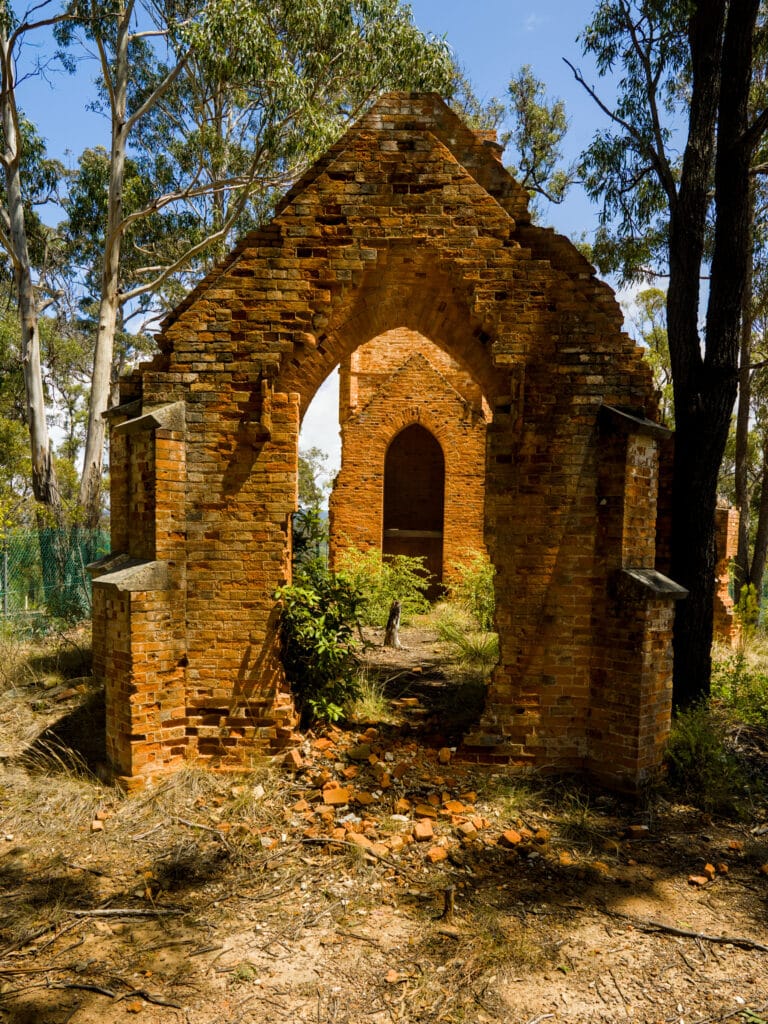
Sony A7Rv with Sony FE 24 – 70mm F2.8 GM II lens @ 24mm. 1/800s, f/11.0, 400 ISO.
Boyd’s Tower
Located on Red point, which is the southern lip of Twofold Bay, Boyd’s tower is clear evidence of Boyd’s ambition. The tower was constructed by Boyd for use as a lighthouse for Twofold Bay. Government officials deemed it unsuitable as a lighthouse, however. It served as a whale lookout station for the whalers of Twofold Bay for the remainder of it’s operational life.
When Boyd went broke in 1849, the use and maintenance of the tower were taken over by the Davidson family, operators of the nearby Davidson whaling station, and was used by them into the 20th century.
Visiting the tower is unrestricted, with no tours. The walk into the tower is mostly on raised walkway, and includes descriptive signage regarding both Boyd and the surrounding geology and other features. A number of lookout points include views out over Twofold Bay, with Eden on the central point.
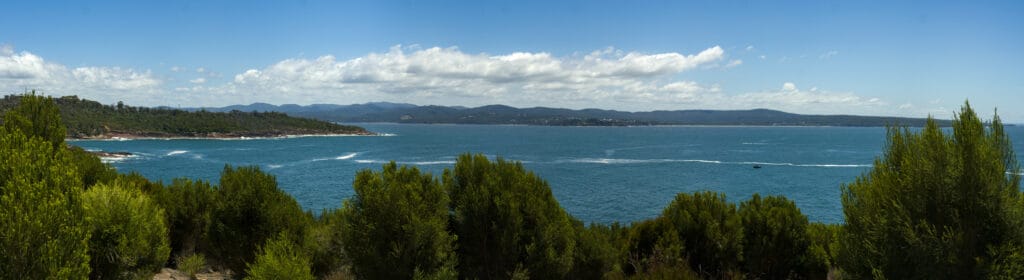
10 image stitched panorama using Autopano Giga..
Boyd’s Tower – external
Bearing clear evidence of Boyd’s ambitions, the tower was emblazoned with Boyd’s name at the top on three sides. It was constructed at no small expense using sandstone imported from Sydney in 1847. It was damaged by a lightning strike in 1860 which resulted in one of the corners of the top parapet being blasted to pieces. That is the corner that is not visible in my photo.
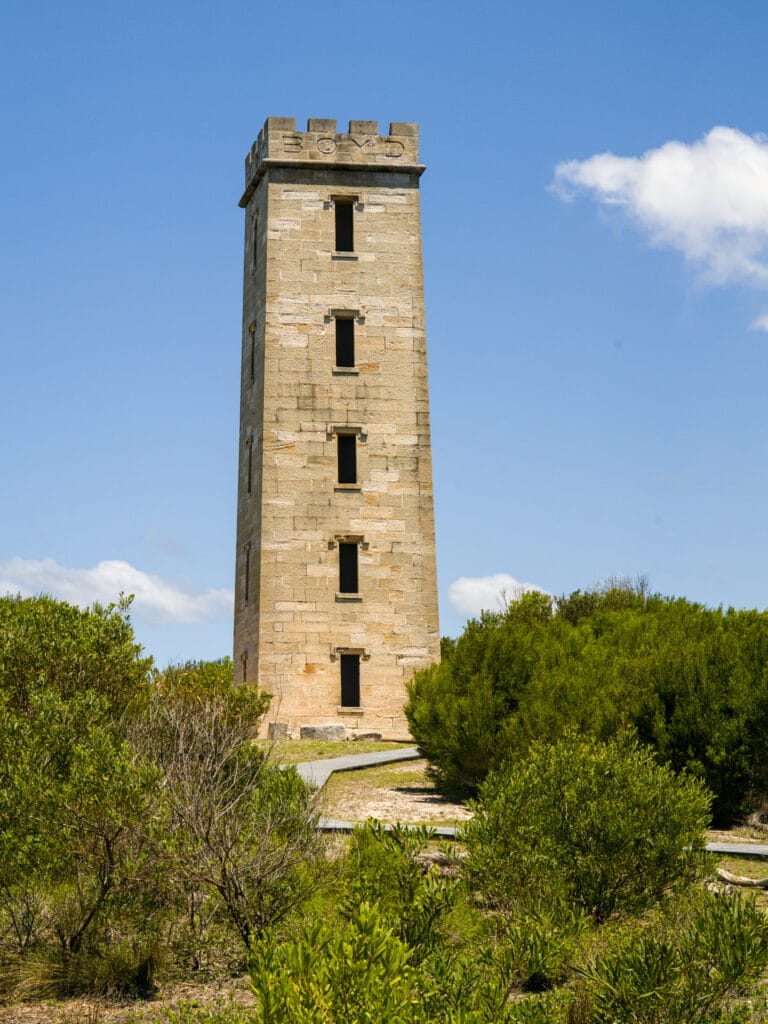
Sony A7RivA with Sony FE 70 – 200mm F2.8 GM II lens @ 70mm. 1/3200s, f/13.0, 800 ISO.
Boyd Tower, internal
The tower has also been affected by several bushfires, and the internal structures that allowed access up the inside no longer exist. It is no longer possible to access the top of the tower. The internal cross beams have been replaced, but there is no flooring or stairs to connect the levels. I presume this has been done to ensure the structure retains integrity.
You can get the feel for how the stairs might have looked by noting the gaps in the beams where the stairs would have gone. It appears (and this is logical) that each set would have been one side clockwise around the tower from the previous. This would allow a smooth accent to the desired level without having to negotiate each level.
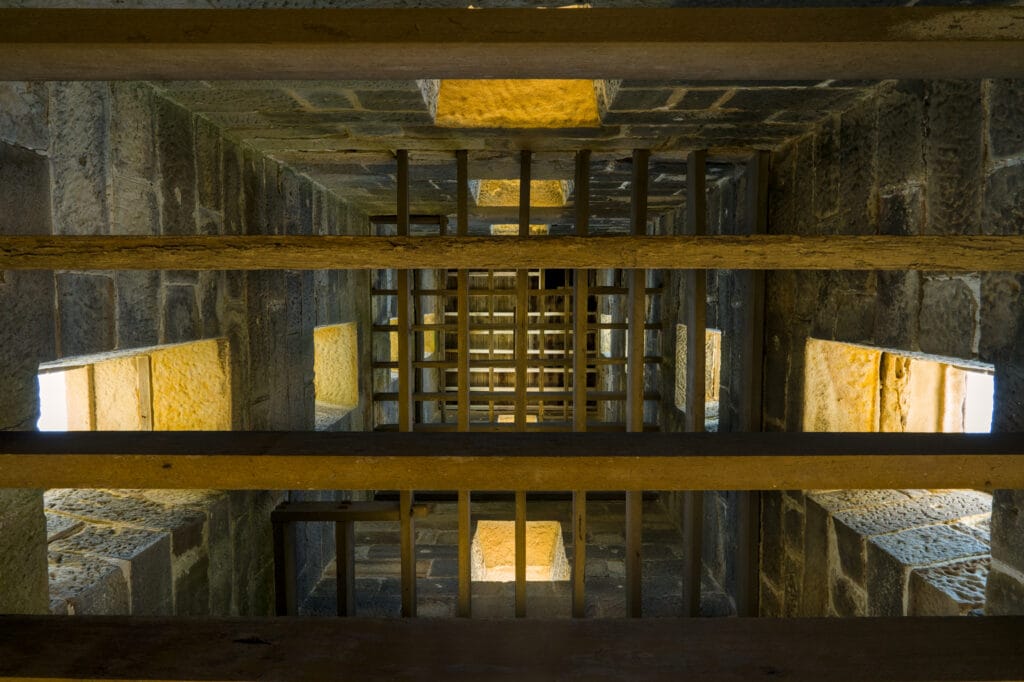
Sony A7Rv with Sony FE 24 – 70mm F2.8 GM II lens @ 24mm. 1/15s, f/16.0, 1250 ISO.
Davidson Whaling Station
The Davidson Whaling Station was the last commercial whaling station on the NSW coast to cease operating. It operated from the 1850s through to 1929. The house that remains on the site is not the original family house, but a cottage built by one of the children in 1896. The original house, Kia House, was destroyed by bushfires in 1926. The remaining Loch Garrah house was lived in by family members through to 1945, when it was sold. After the destruction of Kiah House, Loch Garrah became the focal point of the whaling operations. This included housing and feeding both the family and workers.
The buildings are not normally open. We were fortunate to be able to get there on one of the days during school holidays when NSW Parks (for a fee) provided a guided tour. The guided tours do include visits inside the buildings. Check their website (in the references, below) for details of any upcoming tours. We were also fortunate to have one of the Davidson family descendants present for our tour. They recounted stories of the family and explained the significance of several of the family artifacts that are present.
The kitchen and dining room
When kitchens were mostly wood fired, fire was a real risk. Kitchens often had multiple ovens and fireplaces that were perpetually alight. As was typical of houses of this era, the kitchen was kept separate from the main dwelling. Loch Garrah is not unusual in this regard. The kitchen building contains a large dining room, a food preparation room, and the cooking room. On the near side, the cooking room features a wood stove, an open fire for cooking larger meals and boiling water, and a bread oven. A bathroom, featuring a hatch where hot water could be passed through from the kitchen, is on the other side.
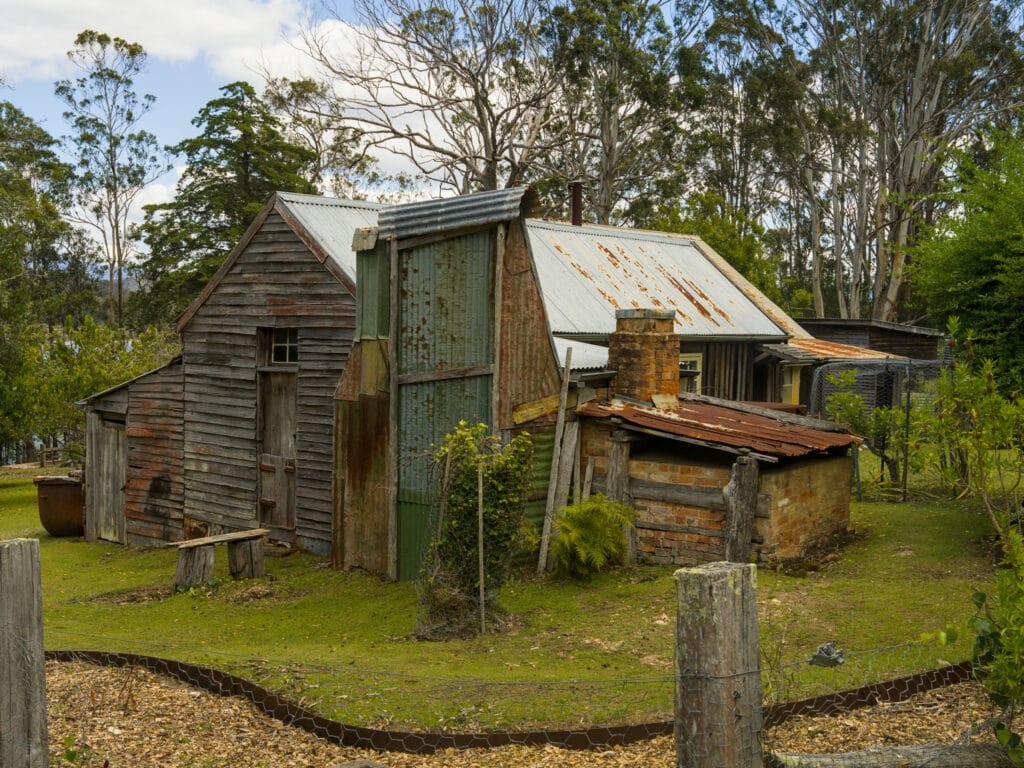
Sony A7Rv with Sony FE 24 – 70mm F2.8 GM II lens @ 36mm. 1/250s, f/16.0, 320 ISO.
Main house and outhouse
The main house was extended several times over the years. The part of the building nearest the outhouse is actually a 1950’s addition that added an indoor kitchen and dining room. It still sports much of its 1950’s cupboards.
The rest of the house is apparently largely unchanged from when the Davidson’s sold it. While it was a working whaling station, this cottage was the primary accommodation for the family and workers. That was particularly so after Kiah House burnt down. The house could be a bit crowded, so the women and girls got to sleep in the bedrooms. The men and boys had to climb up an outside ladder to sleep in the attic.
The gardens are largely in their 1950’s layout. Several plantings in the gardens from the Davidson era, including a number of fruit trees, still exist. However, the garden does not reflect the working garden of it’s heyday. The property was highly self-sufficient, even though Eden is only 5km away over the water. It is a 34km trip by road, and that would amount to a full days trip each way for a horse and cart.
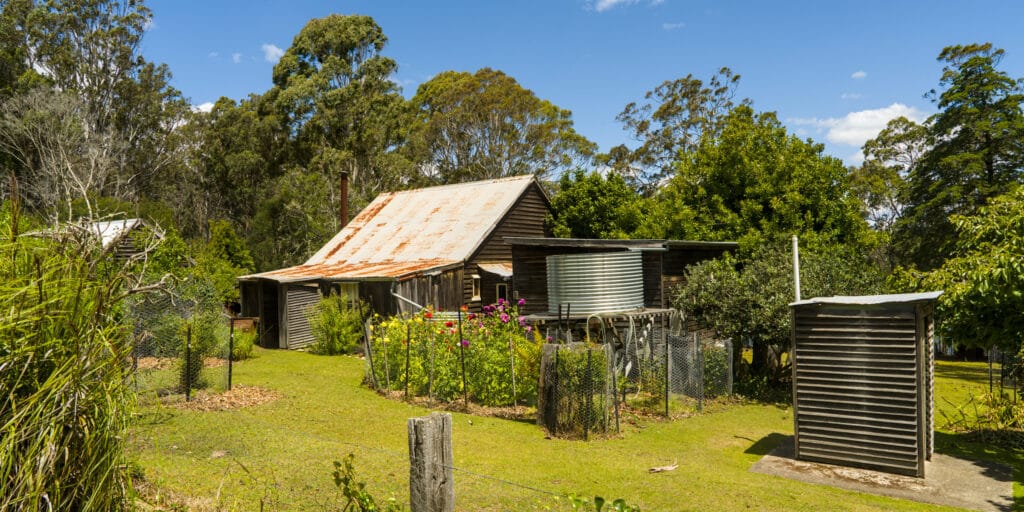
Sony A7Rv with Sony FE 24 – 70mm F2.8 GM II lens @ 24mm. 1/250s, f/16.0, 250 ISO.
References
Old Boydtown Church (history website)
Boyd’s Tower (NSW National Parks website)
Davidson Whaling Station (NSW National Parks website)
Notes
Access to Boydstown is free, and is approximately a 10km drive from Eden. Apart from the effort of getting up the hill, access to the church ruins does not appear to be restricted. The Seahorse Inn is publicly accessible but note that it is an operating business. Most of the rest of the former area of Boydtown is private land (mostly caravan park) and should only be accessed with permission.
Access to the southern part of Beowa National Park, including Boyd’s Tower, is not free. At the time of writing (February 2026), an $8 per day park entry fee applies per car. unless you hold an applicable parks pass.
Access to the Davidson Whaling Station Historic Site is free, but does not include the tour or access to the buildings. You can wander around the designated paths and read the pretty good descriptive signage at your leisure.
It is a 34 km drive from Eden to the Davidson Whaling Station or Boyd’s Tower. That includes some dirt roads to access either site. The roads were well maintained when we visited, but be aware that conditions may change and may not always be suitable for your vehicle. The dirt roads are often narrow and do not always have space for two vehicles to pass. Drive with care and be mindful of road conditions. The relevant pages of the NSW Parks website will most likely note if there are access concerns.
Mobile phone coverage is not guaranteed in all areas along the trip.
Thanks and acknowledgements
I would like to thank NSW National Parks and Wildlife Service for the tour of the Davidson Whaling Station. I would also like to thank the Davidson family for having a family member available. That added a valuable personal touch to the stories.
We were paying guests on a public tour, and did not receive any preferential treatment.
Leave a Reply