

Jerrabomberra Wetlands
The February 2026 Be Curious Photo Walk was an early (for me, anyway!) walk at the Jerrabombera Wetlands, near Fyshwick in Canberra. It was an 8am start. Add 30 minutes of driving time to get there, and that made it very early for a weekend. But I made it!
It was a beautiful morning. Not too hot, to start with, and the morning sun produced the contrasts in lighting that I like. It had warmed up quite considerably by 10am when we finished, though. I was very happy to sit down and enjoy a drink and a chat with the other Curious people.
Ineffective gateposts
Being an early start gave us some beautiful light to play with. This shot was a test shot as I set up the camera for the walk. I liked it and kept it. The gentle, low light and the resultant shadows gave the fenceposts a bit of a gentle but disconnected feel. Helped considerably by the absence of any actual fence.
Since this was an excellent location for photographing birds, I decided I would focus (pun intended) on using a longer lens. I wasn’t feeling up to carrying my very heavy 200-600mm lens around, so I left it at home. Instead, I settled with putting the 2x teleconverter on the 70-200mm lens. Very unusally for me, I used that combination exclusively for the whole walk. I was carrying the other body with the 24-70mm lens on it, but it didn’t come off the belt once.
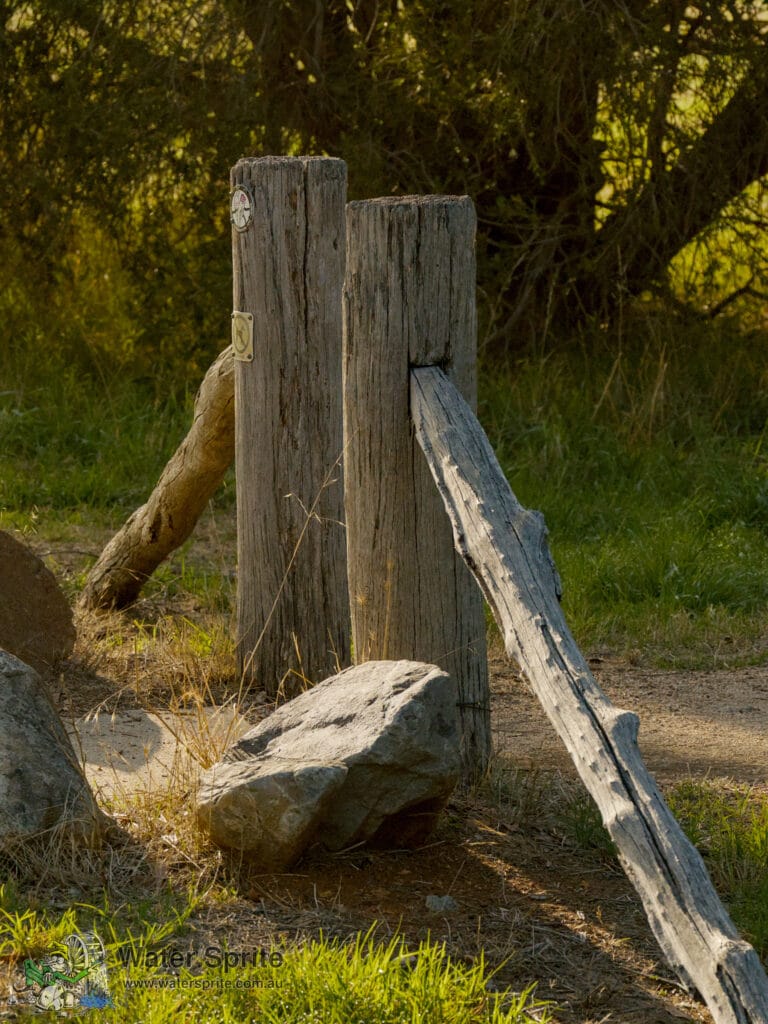
Sony A7RivA with Sony FE 70 – 200mm F2.8 GM II lens with Sony 2x teleconverter @ 204mm. 1/3200s, f/13.0, 8000 ISO.
Very Ineffective Gatepost
This random post was sticking up from the pond. I don’t know what it is there for. I’m sure that it serves as a resting spot for birds at various times, but it wasn’t in use for that purpose on this day. It doesn’t seem likely that someone would have put it there just for that purpose, however. Perhaps it is a remnant of a former use of this land? I don’t know.
In any case, the solitary pole, combined with it’s reflection and it’s shadow provided an interesting shape. The contrasts between the red pond weed, the green grasses by the pond edge, and the yellow dried grass further away from the pond provided some colour contrast as well.
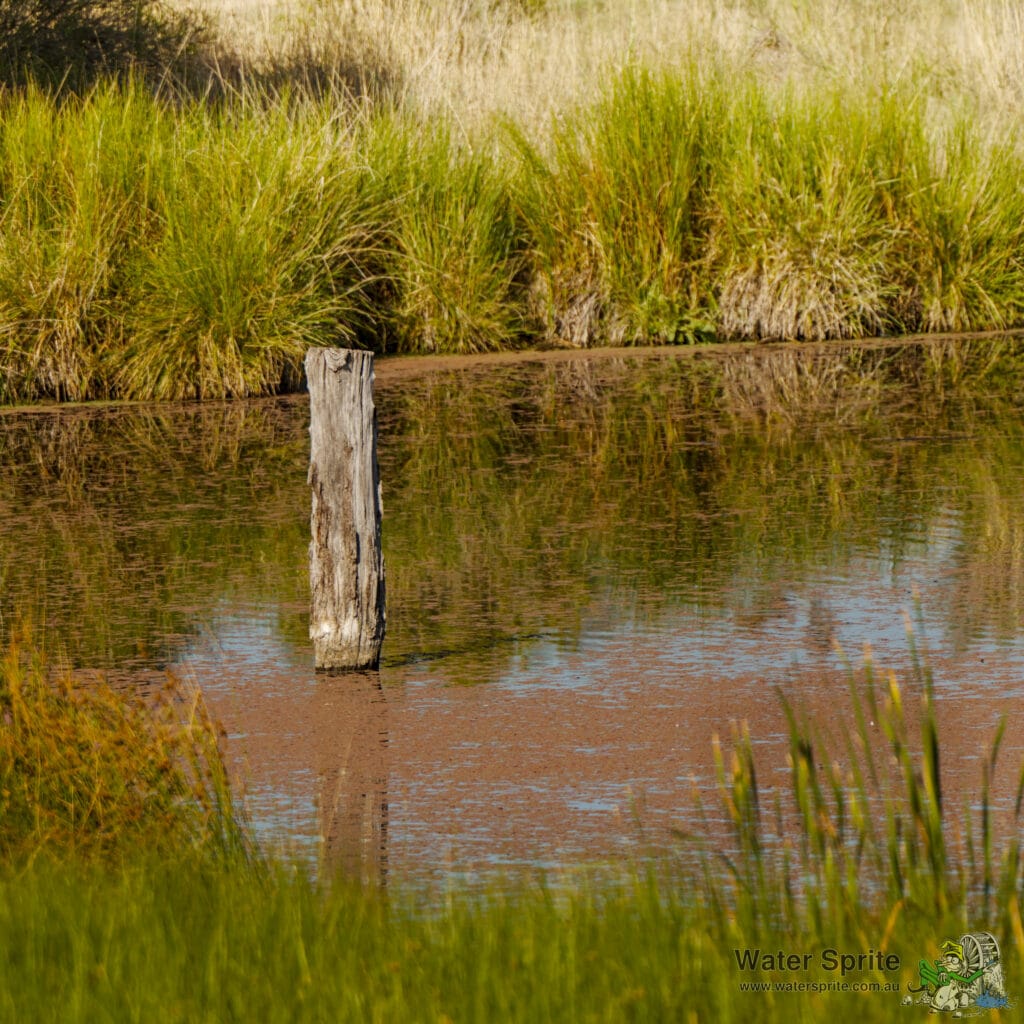
Sony A7RivA with Sony FE 70 – 200mm F2.8 GM II lens and Sony 2x teleconverter @ 400mm. 1/640s, f/6.3, 125 ISO.
Leaf Highlights
I’m not the fastest of photographers, and that’s why I’m a landscape photographer. That and the fact that I actually like landscapes as an artform. I really admire those people who know their camera well enough to be able to get the really quick shots. That is so necessary for wildlife and bird photography. Even with the camera in a heavily automatic mode, I usually find that birds have moved on by the time I’m ready to take the shot. I understand there is also a degree of patience involved, and I might have some deficiencies in that department too.
This photo came about more by accident. There was a small bird flitting about in a tree, not far from me. It didn’t seem too concerned that I was there. It kept on coming back around the same bit of branch, so I lined up and waited (im)patiently. Naturally it chose that time to be distracted elsewhere. While I was waiting, I noticed these leaves moving gently in the breeze in and out of their patch of sunlight. Just the sort of thing I really love photographing. The bird was elsewhere, so I adjusted and took this shot, which isn’t half bad, in my view.
Yes, the bird did come back to the branch while I was taking this shot. No, I didn’t capture the bird shot. I gave up shortly after this and went to look elsewhere.
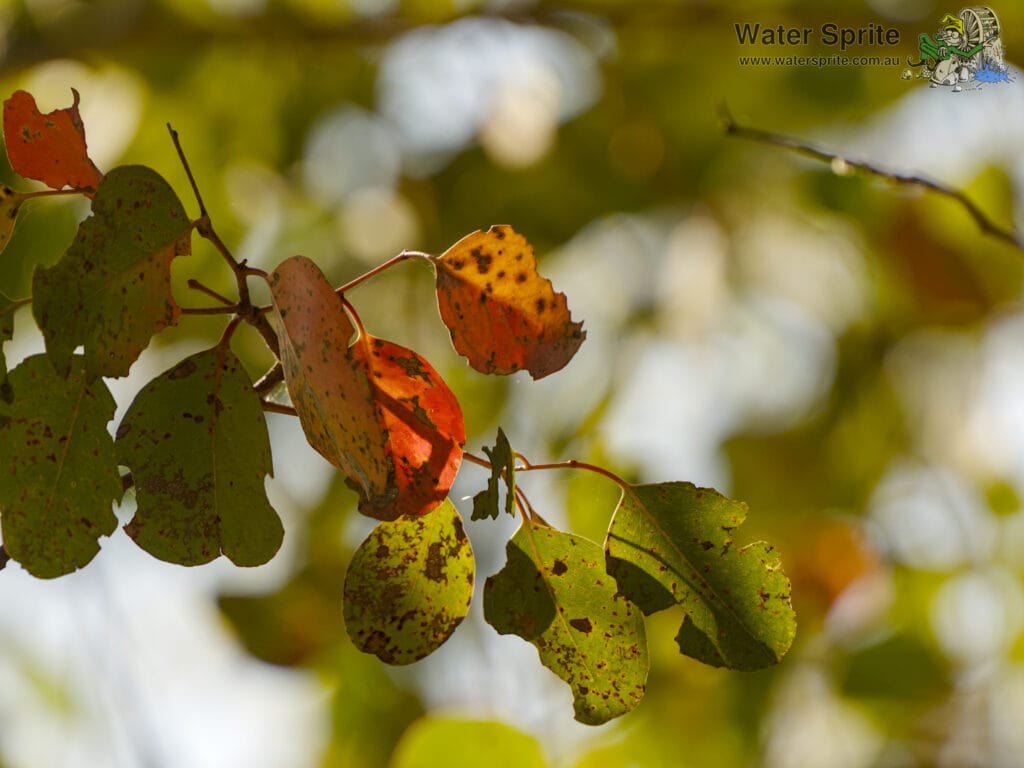
Sony A7RivA with Sony FE 70 – 200mm F2.8 GM II lens and Sony 2x teleconverter @ 370mm. 1/640s, f/6.3, 250 ISO.
Obligatory Flower Shot
Anyone who’s followed my photography for any time will know I’m very into flowers as a subject matter. Living in Canberra does make Floriade a compulsory part of our photographic experience. Even beyond that, however, I am usually very much into the flower shots. This walk was a bit different for me, because I did concentrate quite significantly on the bird shots. The results here show that I didn’t get that many worthwhile shots to show for it, though. As with everything, however, we need to practice. It is only by practicing that we develop the skills to become truly good at our art.
As the end time for the walk came along, I headed back to the meet-up point. Traditionally there is a post-walk social chat for those who want to stay. I saw this flower in the sun on the way. While I feel my horticultural studies should enable me to tell you what it is… But I can’t. It was a nice enough shot, and the only flower shot I took for the entire walk.
If you’re interested in joining us for a walk, they’re generally open to the public. Most of the time, they’re even free, unless the venue has a charge. Search for Be Curious Photo Walks on Facebook. The post-walk social chat is not compulsory if that is not your thing. If you do stay, however, you can learn a lot from the people there. Cristy, who organises the walks, is a veritable treasure trove of information on photography and insects. Other regular walkers have their own specialties, and most people are happy to share knowledge.

Sony A7RivA with Sony FE 70 – 200mm F2.8 GM II lens and Sony 2x teleconverter @ 288mm. 1/640s, f/6.3, 125 ISO.
Preening Duck
Actually one of the first shots I took on the walk, while the sun was still quite low and gentle. It would have been a lot better if the light had been on the duck, and less on the background. I knew that at the time, but I wasn’t going to hang around. I would be counting on the hope that the light would eventually move in the right way, and the swamp hen wouldn’t move.
What really appealed to me most in this photo was again the colour contrasts. The purples and reds of the duckweed and the flowers, contrast nicely with the greens of the reeds and bushes. The beautiful gentle morning sun across the scene, provides an additional layer of contrasts.
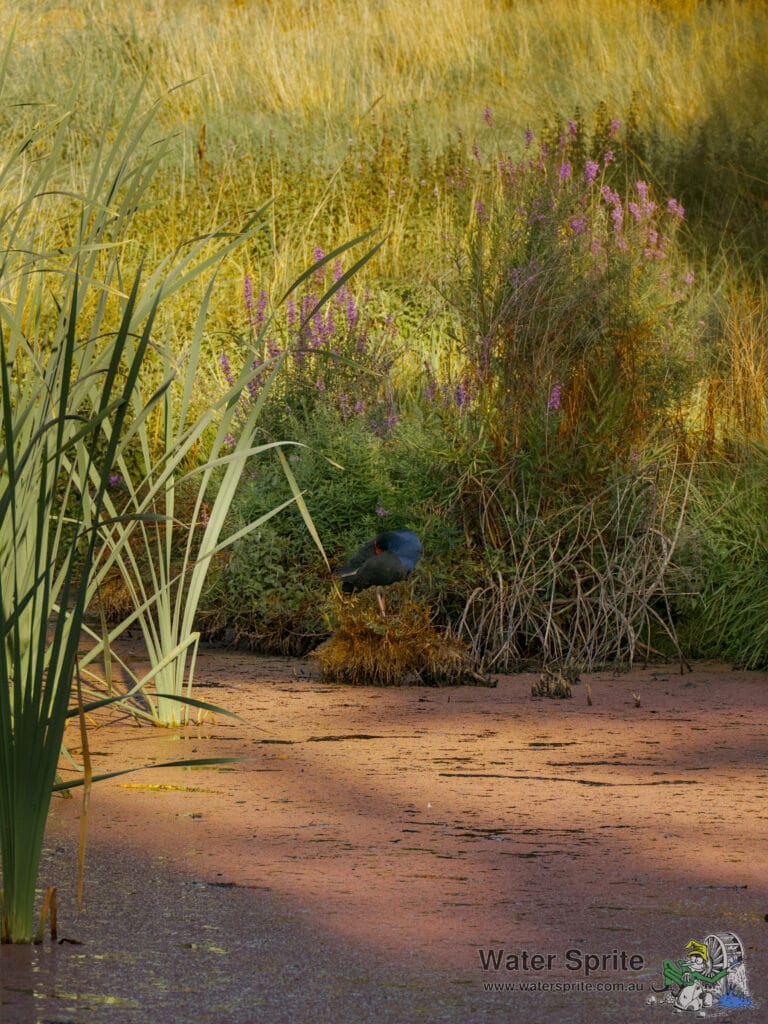
Sony A7RivA with Sony FE 70 – 200mm F2.8 GM II lens and Sony 2x teleconverter @ 400mm. 1/640s, f/13.0, 2500 ISO.
Duck a-la-Muck
There were a number of ducks paddling around in the reddy-orange duckweek on the pond. I waited very patiently for this duck to paddle into a nicely framed shot I had lined up. I had some reeds in the water on either side, and bushes on the land. It would have been an amazing shot, I’m sure! Of course, the duck had other ideas, and promptly turned around and went in a different direction.
I kept this shot because I felt it captured the texture of the water. The depth of field is perhaps a little shallow. An f/8.0 for f/9.0 shot would have brought the pond surface in front of the duck more into focus. That would have given the duck an in-focus area to paddle into.
To be honest, I hardly touched the camera settings after the first few shots. I set the aperture at f/6.3 for a specific shot I was attempting, but then didn’t check or change it for the rest of the walk. That’s a bad habit of mine, and I think it comes from spending too long using cameras on automatic modes. I am still not always remembering to adjust the settings to achieve the effect I am aiming to achieve.
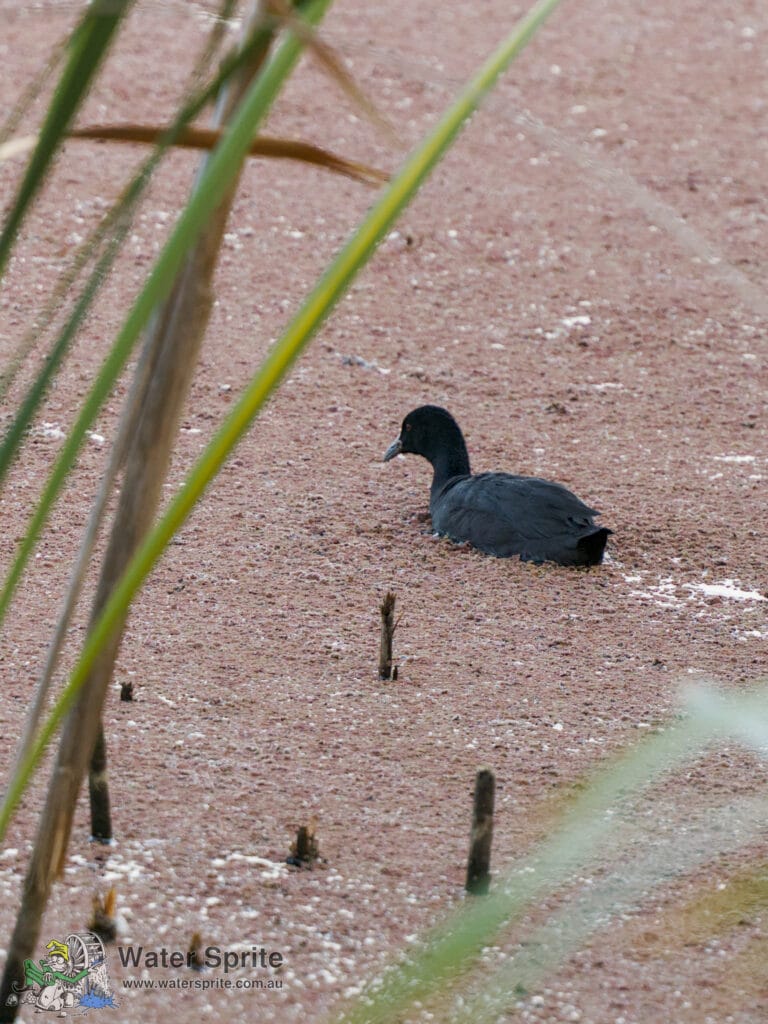
Sony A7RivA with Sony FE 70 – 200mm F2.8 GM II lens and Sony 2x teleconverter @ 376mm. 1/640s, f/6.3, 800 ISO.
Split-second decision
This bird noticed something moving above it just as I started the shutter. It is hunkered down and tense, ready to launch itself into the air. And indeed, that’s exactly what it did. The following shot was taken about a second later. It is a blurry mess as the bird makes a hasty exit from the scene to stage right.
I have my shutter permanently set to multi-shot. It keeps taking photos as long as I hold the button down. I have been shooting that way for years. Most of the time, I can press and release the button quickly enough that I only get one frame. However, by having the camera permanently set this way, when I do want to take multiple shots, I just hold the button down. That’s what I did in this case. Three shots, where this was the first, and the last is devoid of any bird.
I have selected the slowest form of multi-shot on the Sony bodies. These cameras are so fast that they can sustain more than 10 frames a second on fast settings. For almost anything I am doing, that is way overkill. The slow multi-shot gives me a little more than 1 frame a second, which is very adequate for my needs.

Sony A7RivA with Sony FE 70 – 200mm F2.8 GM II lens and Sony 2x teleconverter @ 400mm. 1/640s, f/6.3, 1000 ISO.
Step into the light
This little bird was happily foraging amongst the leaf litter along the edge of the path. I had been standing still for a few minutes, and watched as it slowly hopped close and closer to me. I took this shot as it hopped (almost) into the patch of sunlight. The sunlight gave the shot an extra element of interest, and the reflected light ensured the subject was well lit. The extra brightness also helps to distinguish the light-brown bird from the light-brown background.
This shot might have been better if I had been a bit lower. I was standing normally as I had been waiting (patiently, I promise) for a shot to appear. It didn’t actually occur to me at the time, however. To be honest, I suspect that moving would have startled the bird and there would have been no shot anyway.
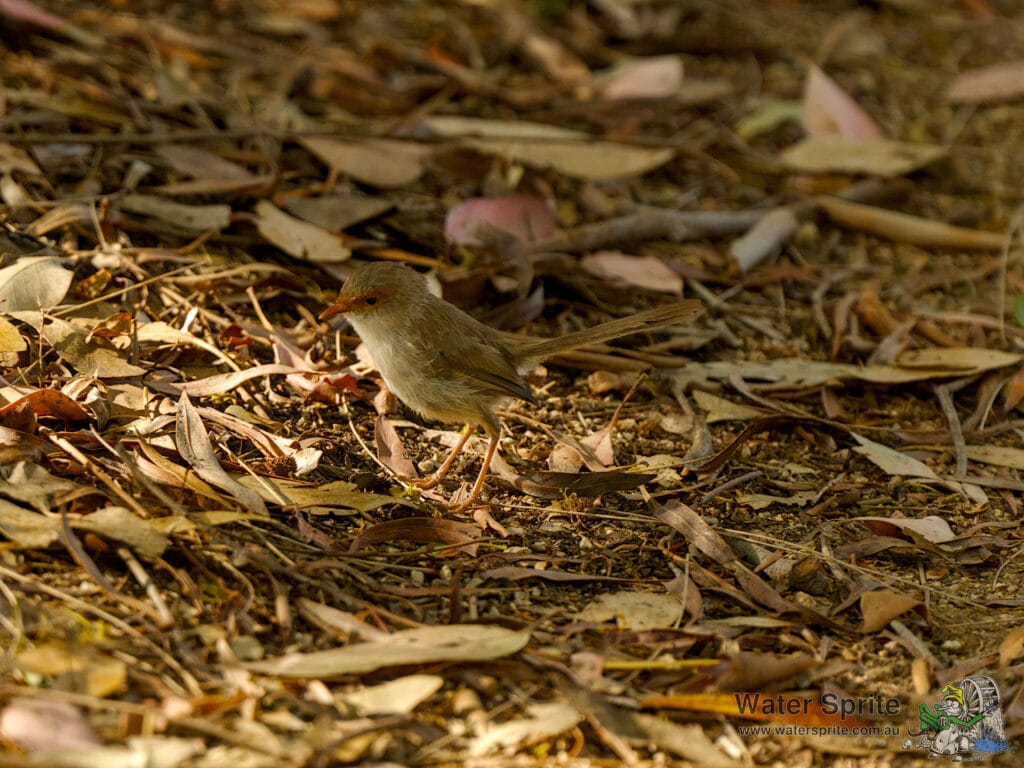
Sony A7RivA with Sony FE 70 – 200mm F2.8 GM II lens and Sony 2x teleconverter @ 400mm. 1/640s, f/6.3, 1600 ISO.
Grass Gymnastics (1) and (2)
In one of the tree-free areas of the pond-side, the grasses were quite tall. Flocks of several species of small birds flitted amongst the grasses. It never ceases to amaze me that they are so light that they can land and sit on a grass stem. I have called these two photos “grass gymnastics” however, because sometimes, the grass stems didn’t take their weight. Watching the little birds darting amongst each other and the grass was a sight to see.
The shadows in these shots are extremely dark compared to the lighting in the rest of the shot. This made processing a bit tricky, and I’m not sure I got it right. I feel the shadows are probably still too dark. Especially as the rest of the grass, being in full sun, is very pale.
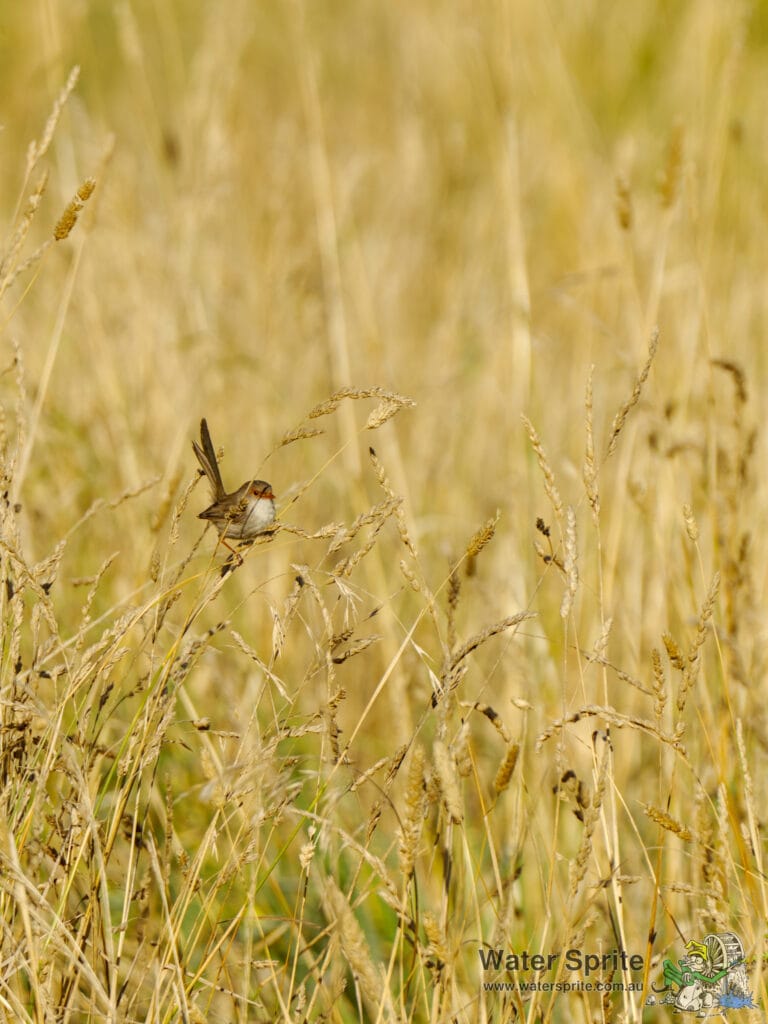
Sony A7RivA with Sony FE 70 – 200mm F2.8 GM II lens and Sony 2x teleconverter @ 400mm. 1/640s, f/6.3, 125 ISO.
For that reason, I like the second image better. Not only is the bird (a blue wren, I think?) a nice contrast to the grass, but the grass itself has more colour and depth to it. I also liked that the bird nicely positioned itself in a gap in the foreground grasses, giving a mostly featureless background behind it.
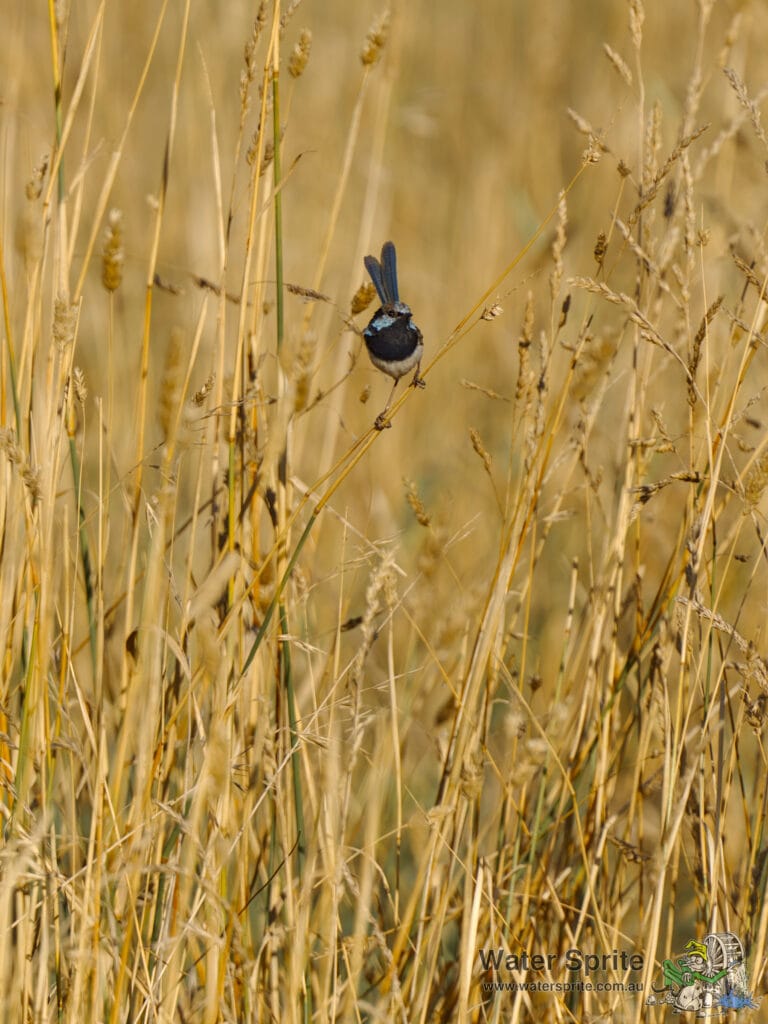
Sony A7RivA with Sony FE 70 – 200mm F2.8 GM II lens and Sony 2x teleconverter @ 388mm. 1/640s, f/6.3, 125 ISO.
Leave a Reply